Harbridge & Quill (fictional demo) Alterspective
InSpective · Sharedo AuditSnapshot · 2026-07-01
Engagement · harbridge-quill-demo

Tier T3 · The flagship visual · roadmap

The Matter Universe: the whole book as one map.

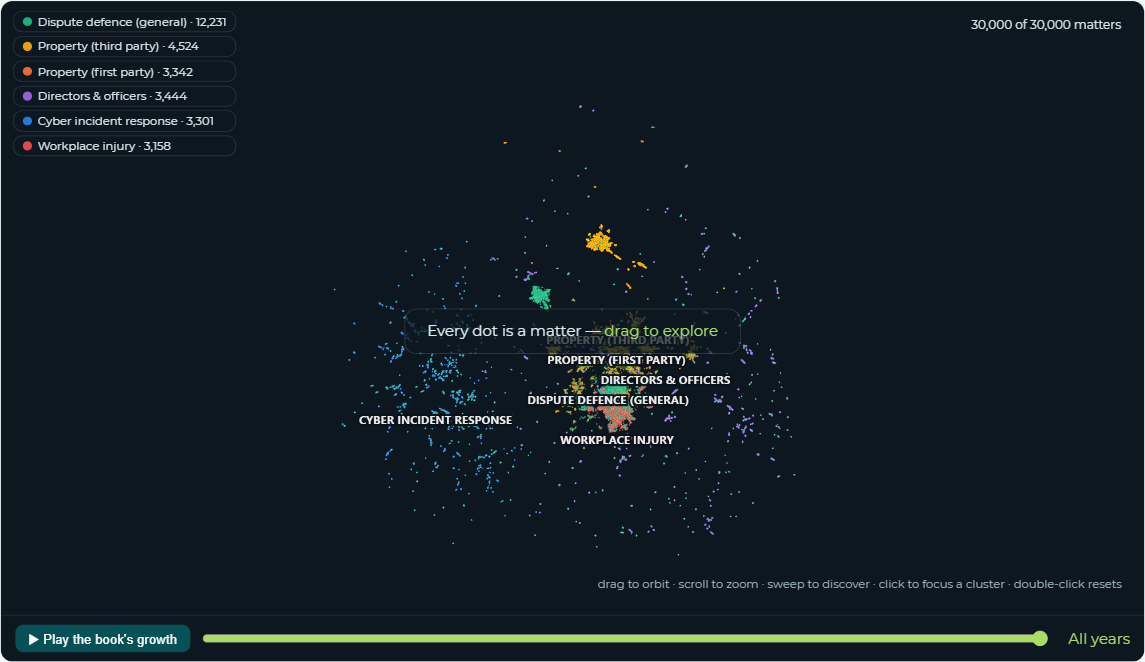
Every one of the 30,000 matter titles became an AI embedding, projected to 3D. Matters that read alike sit together; the axes are abstract, so only proximity carries meaning. Nothing about the layout was told to it: the structure emerged from the data itself.

How to read the map

What this shows

The entire book at once. Every dot is one matter, coloured by practice family; tight clumps are runs of near-identical work, continents are whole practice areas.

How to read it

Sweep the mouse and each region lights up and names itself. Click a region to focus its cluster; click a dot for why the AI placed it there and which matters it reads most like.

Why it matters

This is how the previous chapter's finding becomes visible: the distinct kinds of work hiding inside one configured type sit as separate regions on the map, structure the configured taxonomy cannot see.

Watch for

Nearby points are genuinely similar; the size of a gap between distant clusters is not a measurement. Islands are hypotheses to verify via their membership, not proofs from the picture.

30,000Matters on one map
25AI-discovered communities
7Practice families

The map

The Matter Universe: every matter in the book rendered as one 3D point map, coloured by practice familyLaunch the interactive map →

A real frame of the interactive map. The live page orbits, zooms, names regions on hover, and replays the book's growth year by year.

Launch the interactive Matter Universe → Taxonomy drill-down →

Why are there islands? A clump floating far from the main mass is a group of matters whose language is unlike everything else in the book, typically one client's production-line work or a distinct product line. Treat an island as a question, not an answer: click it, read its members, and let the cluster name itself. On the live engagement, every island inspected resolved to a single-origin templated book of matters.
Read honestly: the projection preserves local similarity, so points near each other genuinely read alike. Global distances are an artifact of the projection: never quote the gap between two clusters as a quantity. Cluster labels are model-derived inferences; membership and counts are computed.
Method: 3D UMAP of matter-title embeddings (all-MiniLM-L6-v2); axes are abstract semantic space, so proximity means similarity. · 25 semantic communities (KMeans over title embeddings) · labels: llm:qwen3-next-80b@sglang · WebGL point rendering · computed on-premise, so no data left the controlled environment.
From the live engagement
The production version of this map rendered a live book of 50,000+ matters as WebGL point sprites, smooth to orbit on desktop hardware. Its islands, on inspection, turned out to be single-origin templated books; the picture raised the question, and cluster membership answered it.
roadmap On our roadmap: this lens is proven on a live client engagement and is being generalised into the productised pipeline (alongside Configuration and Lifecycle, which are shipped today). The numbers on this page are real, computed directly from the synthetic corpus, but the lens is not yet a formal, re-runnable step in insights.audit.
Continue the reportNext: Entity Resolution →
← Back to the InSpective site